
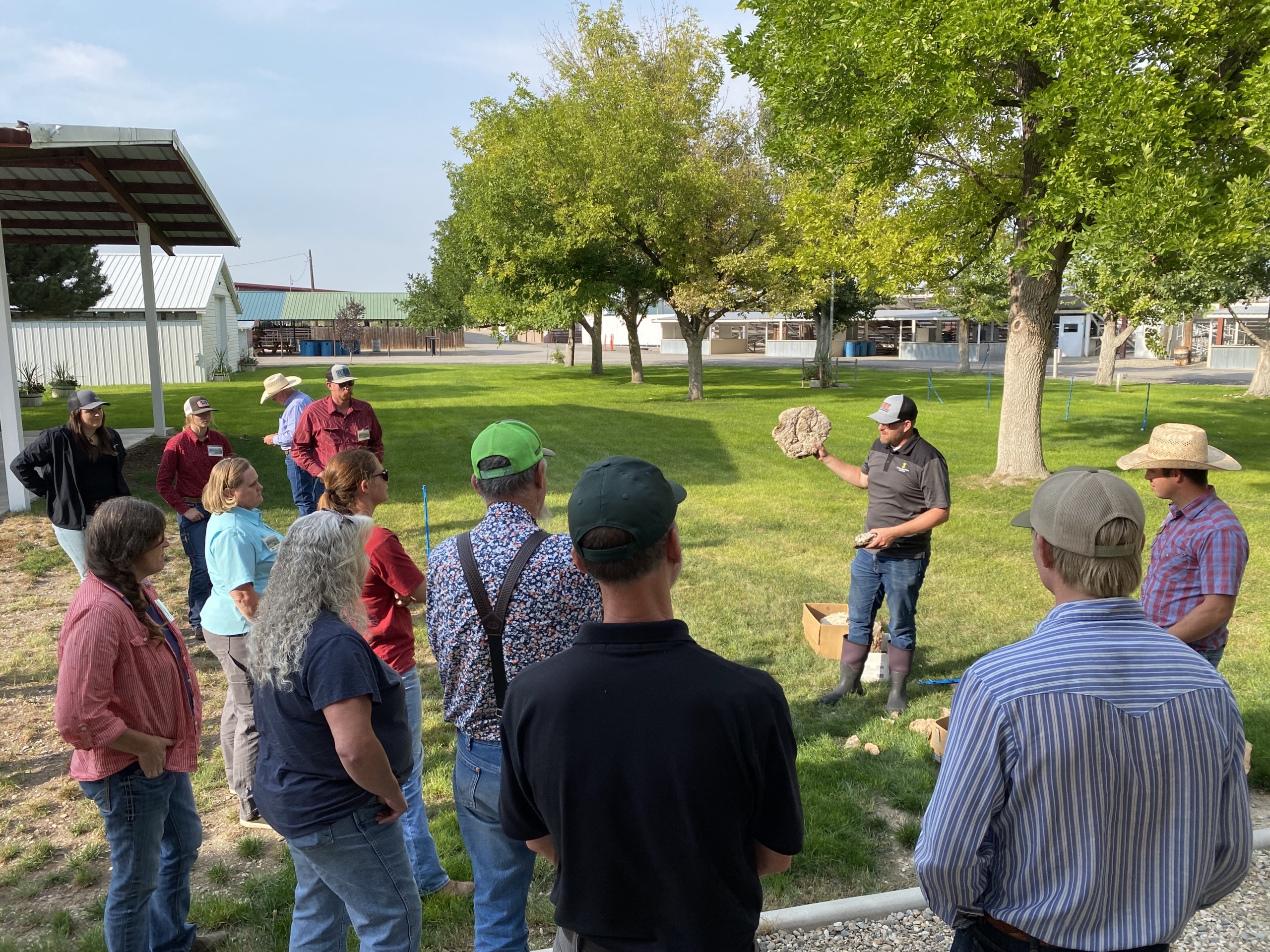
Thanks to an American Farmland Trust Soil Health Stewards grant, this September, the Land Trust was able to provide a scholarship to the Lost Rivers Grazing Academy in Marsing, Idaho. The recipient of the scholarship, Russell Clark, owns and operates Roots and Grow Farm LLC in Fremont County, Idaho. Russell raises grass-fed beef cattle on approximately 50 acres of rotationally grazed pasture and 40 acres of irrigated alfalfa.
Prior to attending the Lost Rivers Grazing Academy (LRGA), Russell’s approach was rooted in regenerative principles such as no-till, no chemical inputs, and an emphasis on soil health, biodiversity, and sustainability. Through attending LRGA, Russell hoped to strengthen his grazing system, maximize pasture productivity, and improve water and labor efficiency across his operation.
Regarding LRGA Russell wrote, “The instructors framed Management-intensive Grazing (MiG) as an umbrella term for a family of approaches (cell grazing, short-duration/high-intensity grazing, AMP, mob grazing, UHSD, regenerative grazing, Voisin/Rational grazing, etc.) and emphasized that MiG is proven both anecdotally and empirically; it’s simply under-used today, but by no means new, instead just seemingly forgot and fallen out of current favor. However, and pun intended, a grass-roots movement is emerging as more people recognize the importance and impact of holistic agricultural practices and value livestock can have when managed properly!”
Russell also reported that stock density is the single most important factor to keep in mind. According to Russell, “using higher stock density for short periods and then giving pastures adequate rest optimizes photosynthetic efficiency, soil biology, water infiltration, soil temperature, and overall resilience. The “Take half, leave half” (or other target residuals based on context) is a practical rule of thumb to keep plants in their most productive growth phase.”
Going forward, Russell wrote “by combining higher stock density moves with better rest, improved water/fence infrastructure, and careful economic planning, I expect to increase my pastures’ carrying capacity, extend the grazing season, reduce winter feed costs, improve soil and water outcomes, and increase net income while building long-term resilience.”
We wish Russell the best of luck in his endeavors and we would love to discuss your pasture management goals with you during a future site visit. -Nicole Cyr, Stewardship Associate